
(No caption)
This columnist, a Deadline Detroit contributor, is publisher and editor of the biweekly newsletter Inside Michigan Politics.
By Susan J. Demas
State Rep. Sam Singh, D-East Lansing, isn’t in Congress or a Democratic National Convention superdelegate. But that hasn’t stopped Bernie Sanders supporters from posting on Facebook that he should “support the will of the people.”
At least the Sanders activists have U.S. Rep. Brenda Lawrence, D-Southfield, pegged correctly. The congresswoman does back Hillary Clinton, just as more than 60 percent of her 14th District did in the March 8 primary.
Lawrence believes “hands down, that Hillary Clinton is clearly the highest-qualified candidate running for president in either party,” as campaign manager Christy Jensen says.
When Lawrence bumps into Sanders supporters at events, they’re always “kind and respectful,” Jensen adds. The same can’t be said about the flood of “bashing” phone calls and Facebook posts in which the congresswoman is “called horrible names –– things you can’t print.” Those have been taken down, but plenty of angry comments remain.
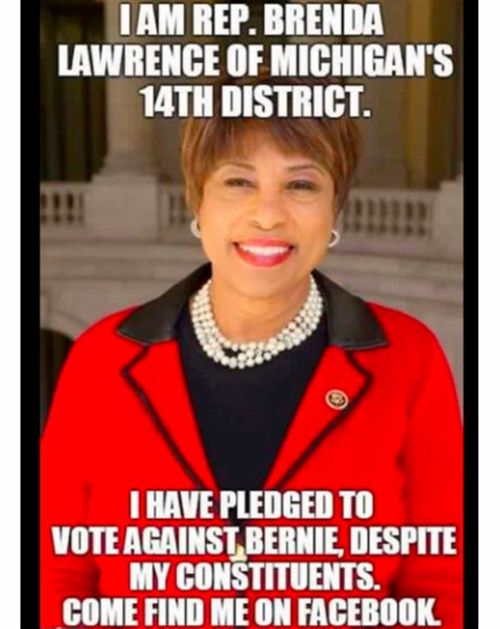
This Facebook meme targets the Clinton-supporting congresswoman, a Democratic superdelegate.
An innocuous Facebook post last month about a national arts competition was typically spammed by Sanders supporters. “You need to look in mirror and be a true representer of your district," one warns. "Please vote the way your district votes . . . this IS your job.”
Undercover Republicans?
Who knows if these commenters live in Michigan or could even find the 14th District on a map. Jensen speculates that many of the so-called “Bernie Bros” may be far-right operatives trying to create chaos in the opposing party.
Lawrence is far from the only superdelegate targeted in Michigan or nationally. An outrage-fueled online campaign includes sending automatic tweets to supers, tying up phone lines, posting memes with their pictures that urge Sanders supporters to “come find me on Facebook” (as shown at right) and even publishing their personal information online.
How did things start to spin out of control?
Sanders has been harping on superdelegates for months, first complaining they were unfair and then announcing his campaign will try to turn them. The senator hasn’t endorsed the more extreme tactics against superdelegates, but he hasn’t gone out of his way to tell folks to simmer down.
Fortunately, the harassment strategy seem to have died down a bit. Maybe reality and math are setting in.
'A Fairly Specious Claim'
After all, Sanders lost big Tuesday in New York. To clinch the nomination, he needs roughly 60 percent of the remaining pledged (not super) delegates, with primaries ahead in unfavorable states such as Pennsylvania and Maryland.
In other words, Sanders is now officially a longshot.
However, Sanders adviser Jeff Weaver isn’t waving the white flag. He declared Tuesday night that the campaign is going all in on wooing superdelegates. The new line of argument is that Sanders is a stronger general election candidate, so supers should flip to him.
That’s a fairly specious claim.
Clinton has been bloodied for decades and has received the most negative coverage this campaign, per Vox –– more than bigoted blowhard Donald Trump. GOP operatives have barely laid a glove on Sanders –– they’d rather run against him because they think he’s a weaker candidate than Clinton. That may not be correct, but is what conservatives calculate.
Then again, too many Sanders supporters seem to believe that superdelegates are a new Democratic National Committee plot to deny Sanders the nomination. Love ‘em or hate ‘em (I’m personally not a fan), but superdelegates have been around for years.
Obama Wasn't Flummoxed
The last Democratic presidential upstart, Barack Obama, figured out a way to win under similar rules. I know. I reported extensively on the 2008 delegate fight in Michigan and nationally, examining Obama’s meticulous long game and Clinton’s myriad miscalculations.
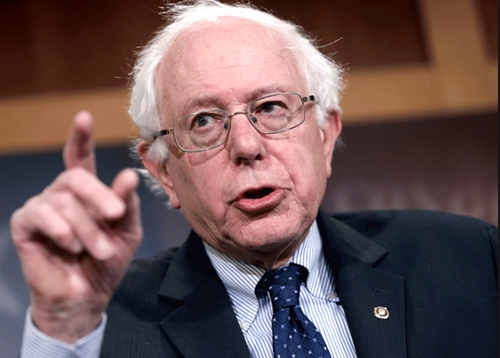
Bernie Sanders' campaign argues that he's a stronger November candidate, so superdelegates should flip to him.
So my pro-math record is established, even though diehard Sanders supporters don’t care. Back in ‘08, Clintonistas sent me hate mail over it.
This year, Clinton wised up and hired many of Obama’s nerds to help her navigate the process. I respect politicians who learn from mistakes instead of whining about unfairness.
If Team Sanders goes all in with the superdelegate strategy, it will almost certainly flop.
Elections are popularity contests. And the truth is that the prickly independent senator isn’t exactly beloved by Democratic leaders, though he’s certainly not as loathed by colleagues as Ted Cruz is. That’s a big reason why Sanders lags in superdelegates.
Maybe Weaver’s vow is the flailing bluster of a doomed campaign. Maybe it will rev up unhinged Sanders supporters to start their superdelegate cyber-stalking again.
Whatever the case, it’s going to do precious little to derail Hillary Clinton’s march to the nomination.
Susan J. Demas is publisher-editor of Inside Michigan Politics, a biweekly political newsletter. Her columns are at SusanJDemas.com. Follow her on Twitter.


